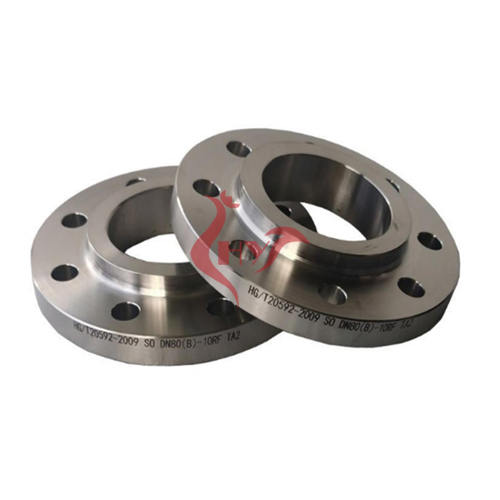
1. Why Choose Titanium Flanges?
Titanium flanges are not merely substitutes for ordinary metal components; they are high-performance solutions engineered for extreme operating conditions.
When stainless steel succumbs to chloride-induced corrosion, and heavy steel flanges impose significant weight penalties on systems, titanium flange offer a fundamentally different solution. Their value extends far beyond simple "corrosion resistance":
"Immune-Grade" Corrosion Resistance: Exhibits near-perfect tolerance to chlorides (seawater, wet chlorine gas), organic acids (acetic acid, formic acid), and oxidizing media (sodium hypochlorite, chlorate). Service life can be 5-10 times longer than stainless steel, fundamentally eliminating unplanned downtime.
Exceptional Strength-to-Weight Ratio: With a density only 60% that of steel, yet strength comparable to high-strength steel. This means in weight-sensitive applications like offshore platforms and aerospace, it significantly reduces structural load and improves system energy efficiency.
Broad Temperature Resistance & Bio-Inertness: Operates reliably long-term across a wide temperature range from -196°C to 540°C. Simultaneously, its non-toxic, non-leaching properties perfectly meet the stringent hygiene standards of pharmaceutical, food, and bioengineering industries.
Core Application Fields:
The "Lifeline" of Chlor-Alkali Industry: Electrolyzers, chlorine gas cooling and drying sections.
The "Guardian" of the Ocean Economy: High-pressure pipelines in seawater desalination, offshore platform drilling pipelines, ship heat exchange systems.
The "Key Component" in Advanced Manufacturing: New energy lithium battery slurry transportation, pharmaceutical sterile piping, specialty chemical synthesis units.
2. Titanium Flanges Common Specifications & Models Quick Reference Chart
The table below summarizes commonly used titanium flanges specifications conforming to major international standards, providing a essential reference for your selection process.
Nominal Diameter (DN) | Execution Standards | Pressure Rating (Class) | Sealing Face Types | Primary Application Media & Industries |
15 - 50 | GB/T 9119, ASME B16.5, DIN 2631 | 150LB - 300LB | RF/FF/MFM | Chlor-alkali industry, laboratory pipelines, fine chemicals |
65 - 150 | HG/T 20592, EN 1092-1, ASME B16.5 | 600LB - 900LB | RF/RJ/TG | Chemical slurry transport, wet chlorine gas mains, seawater heat exchangers |
200 - 500 | ASME B16.47, JIS B2220, HG/T 20592 | 1500LB - 2500LB | RF/EJT | High-temperature acetic acid units, bromine processing, large offshore platform water transmission |
Common Titanium Material Grades:
Chinese Standards: TA1, TA2 (Commercial Pure Titanium)
ASTM Standards: Gr1, Gr2 (Commercial Pure Titanium)
Characteristic Explanation: GR1/TA1 offers better plasticity, while GR2/TA2 provides a balance of strength and plasticity, making it the most commonly used grade; GR5 is used for applications requiring higher strength and heat resistance.
Email: nwhengyimetal@gmail.com
Whatsapp: +86 13891704215