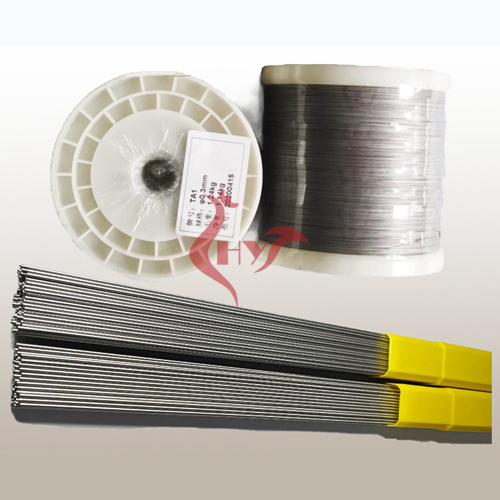
Titanium Wire: Forging Resilient Pathways for Industry and Life with Flexible Strength
In the world of high-end manufacturing, there exists a material that possesses both the strength of metal and the flexibility of a thread. It is titanium wire—a high-tech product that condenses the exceptional properties of titanium into fine filaments. It is not only the cornerstone of precision weaving but also the resilient pathway connecting modern industry and cutting-edge medicine.
High Specific Strength, Lightweight Advancement: The strength of titanium wire is comparable to high-quality steel, yet its density is only 57% that of steel. This characteristic enables weight reduction and efficiency improvements in fields like aerospace and high-end equipment, making it the preferred material for lightweight design.
Unrivaled Corrosion Resistance: The dense oxide film instantly formed on its surface can resist erosion from seawater, chloride ions, and various acids and alkalis. Its service life far exceeds that of traditional metal wires like stainless steel and nickel wire, making it a "stainless legend" in chemical and marine engineering.
Perfect Biocompatibility: This is the core advantage of medical titanium wire. Human tissues show almost no rejection reaction to it, allowing for safe and permanent implantation and harmonious coexistence with the human body environment. It is an ideal material for implantable medical devices.
Excellent Flexibility and Workability: Through precision drawing and annealing treatment, titanium wire exhibits excellent flexibility, ductility, and fatigue strength. It is easy to weave, bend, and form, meeting various complex processing requirements.
I. Classification by Material Grade
This is the most basic classification, determining the fundamental performance of the titanium wire.
Pure Titanium Wire
Grades: GR1, GR2
Characteristics: Moderate strength, good plasticity, excellent corrosion resistance, and optimal biocompatibility. It is the most widely used titanium wire in the medical field.
Applications: Medical implants (e.g., sutures, bone screws, fixation wires), woven mesh, chemical fillers, electrodes, etc.
Titanium Alloy Wire
Grades: GR5 (Ti-6Al-4V, Gr5) is the most commonly used.
Characteristics: High strength, good fatigue resistance, but plasticity is slightly lower than pure titanium. Strength can be further improved through solution and aging treatment.
Applications: Aerospace structural components, high-strength fasteners, high-performance sports equipment, medical devices (e.g., surgical instruments, special implants).
II. Classification by Condition (Annealed State)
The mechanical properties of titanium wire are closely related to its heat treatment state.
Annealed State (M State)
Characteristics: After annealing treatment, internal stress is eliminated, resulting in good plasticity, toughness, and dimensional stability. It is easy for cold processing (such as bending, weaving). Annealed titanium wire is used in most situations.
III. Classification by Size Specifications
The diameter range of titanium wire is very wide, covering from micron level to millimeter level. The following is a list of common specifications:
Ultra-Fine Wire / Micro Wire:
Diameter: 0.05mm, 0.08mm, 0.10mm, 0.12mm, 0.15mm
Application: Precision weaving (e.g., high mesh count titanium mesh), sieve mesh, experimental research.
Fine Wire (Common Range):
Diameter: 0.2mm, 0.3mm, 0.4mm, 0.5mm, 0.6mm, 0.8mm, 1.0mm
Application: The main specification for titanium mesh weaving, also used for welding wire, chemical fillers.
Medical Titanium Wire (Implant Grade)
Requirements: The most stringent, must comply with medical device-related standards (e.g., ASTM F67, ISO 5832-2).
Material: Pure Titanium GR1ELI, GR2ELI (ELI grade, ultra-low interstitial elements, better biocompatibility), or TC4 ELI.
Condition: Annealed state, ensuring no processing stress.
Common Diameters: Varies according to product design, for example:
Orthopedic Fixation Wires (Kirschner Wires, Steel Wires): 0.8mm ~ 2.5mm
Suture Wire: Finer, can be below 0.1mm
Surface Requirements: Extremely high. Requires processes like pickling, electropolishing, etc., to ensure an absolutely clean surface free from any contamination.
Welding Titanium Wire
Material: Usually matches the base material (e.g., GR2 wire for welding GR2 plate, GR5 wire for welding GR5 components).
Condition: Annealed state, clean surface.
Diameter: Commonly 1.0mm, 1.2mm, 1.6mm, 2.0mm, 2.4mm.
Standard: Must comply with welding material standards such as AWS A5.16.
Titanium Wire Common Specifications Quick Reference Table
Application Field | Recommended Material | Recommended Condition | Common Diameter Range (mm) | Key Requirements |
Titanium Mesh Weaving | GR1, GR2 | Annealed (M) | 0.1 - 3.0 | Good flexibility, smooth surface |
Medical Implant | GR1ELI, GR2ELI | Annealed (M) | 0.1 - 3.0 (Product specific) | Implant-grade standards, ultra-clean surface |
3D Printing | GR5, GR1/GR2 | Bright Annealed | 1.0, 1.2, 1.6, 2.0 | Precise dimensions, contamination-free surface |
Welding | Match Base Material | Annealed (M) | 1.0 - 3.2 | Matched composition, clean |
Chemical Filler | GR2 | Annealed (M) | 1.0 - 6.0 | Corrosion resistant, often in loose state |
General Fasteners | GR2, GR5 | Annealed/Hard State | 1.0 - 8.0 | State depends on strength requirements |
Titanium wire, fine as a hair, yet capable of bearing immense loads. With its unique flexibility and strength, it builds a bridge between the macro and micro worlds. From the life-saving mesh that repairs the human body, to the industrial sieve that filters harsh media, and even to the manufacturing ink that prints the future, the presence of titanium wire is everywhere.